
Public Wi‑Fi is finally growing up. The era of wide‑open networks exposing your data is ending, thanks to mandatory security standards in the 6 GHz band. As we move into Wi‑Fi 7, we’re also introducing Multi‑Link Operation (MLO), a feature that lets devices use multiple bands at once. It’s powerful and fast — but how stable is it when paired with Enhanced Open or Opportunistic Wireless Encryption (OWE)? If that’s what you’re interested in, check out this deep dive.
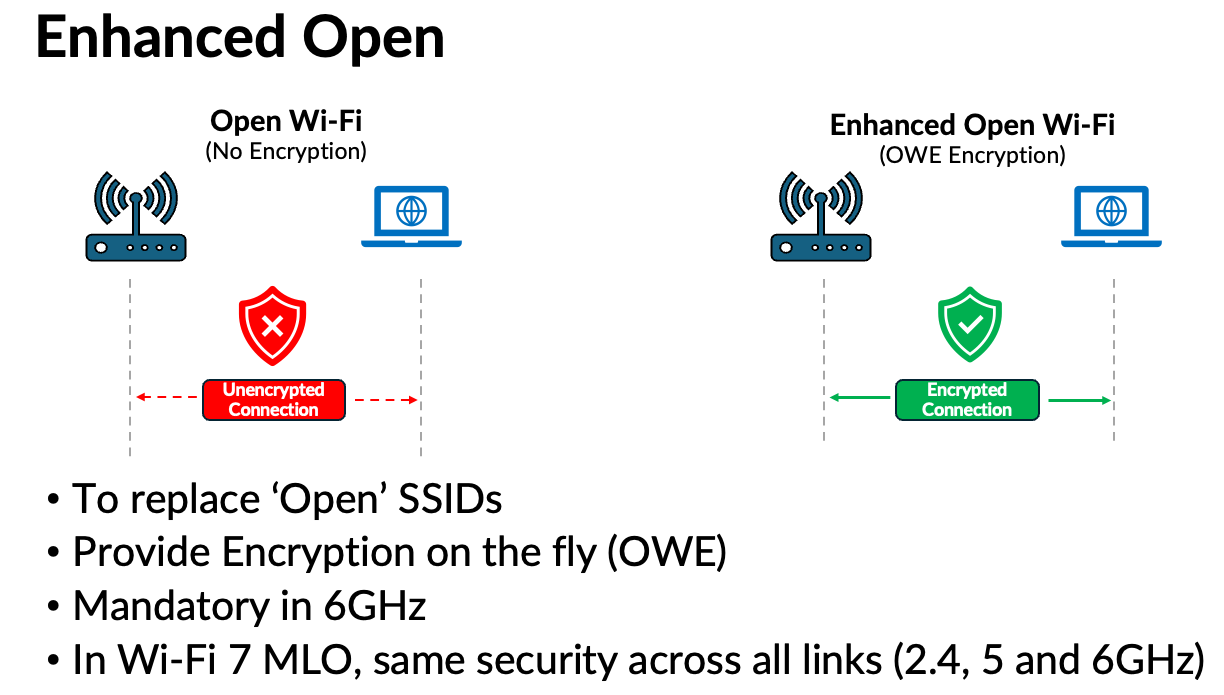
Here is a quick summary of Enhanced Open (or OWE)
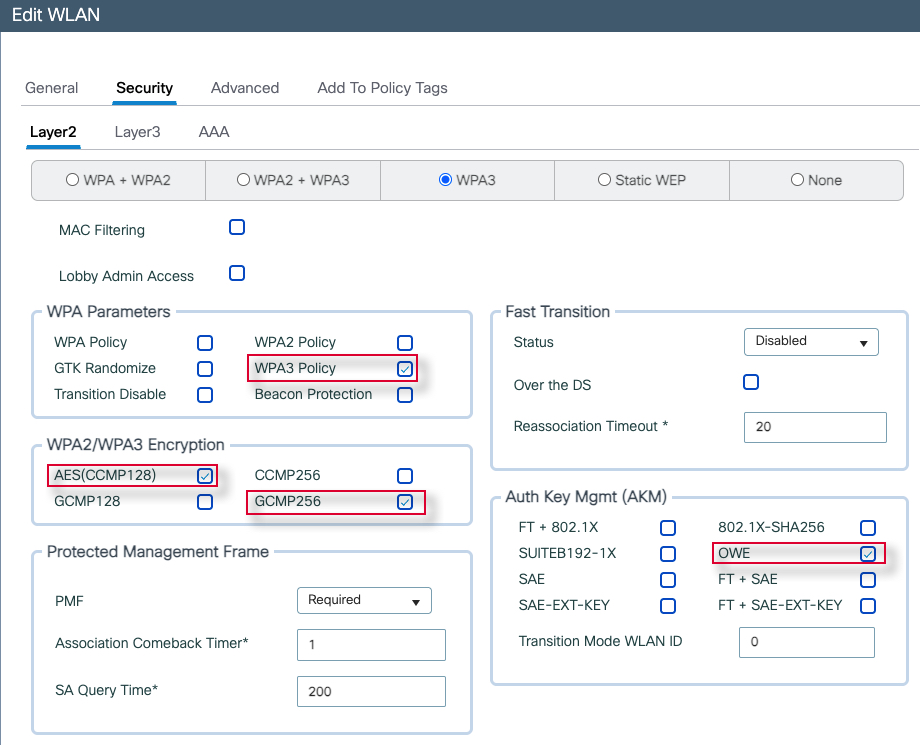
I tested Wi‑Fi 7 MLO connectivity using both Cisco Meraki and a Cisco 9800 setup. Below are the SSID security settings configured on the 9800 WLC. Both CCMP‑128 and GCMP‑256 encryptions were enabled, with the AKM set to OWE. Both my Intel BE200 and Pixel 8 clients were able to successfully establish Wi‑Fi 7 MLO connections using OWE.
With Meraki, I simply selected “Opportunistic Wireless Encryption (OWE)” as the SSID security option. GCMP‑256 was also enabled under the “Advanced WPA3 settings.” With this configuration, I was able to establish MLO connections on both the BE200 and Pixel 8. However, the Pixel 8 connection was not stable, and I’ll need to perform additional testing to determine the exact cause.
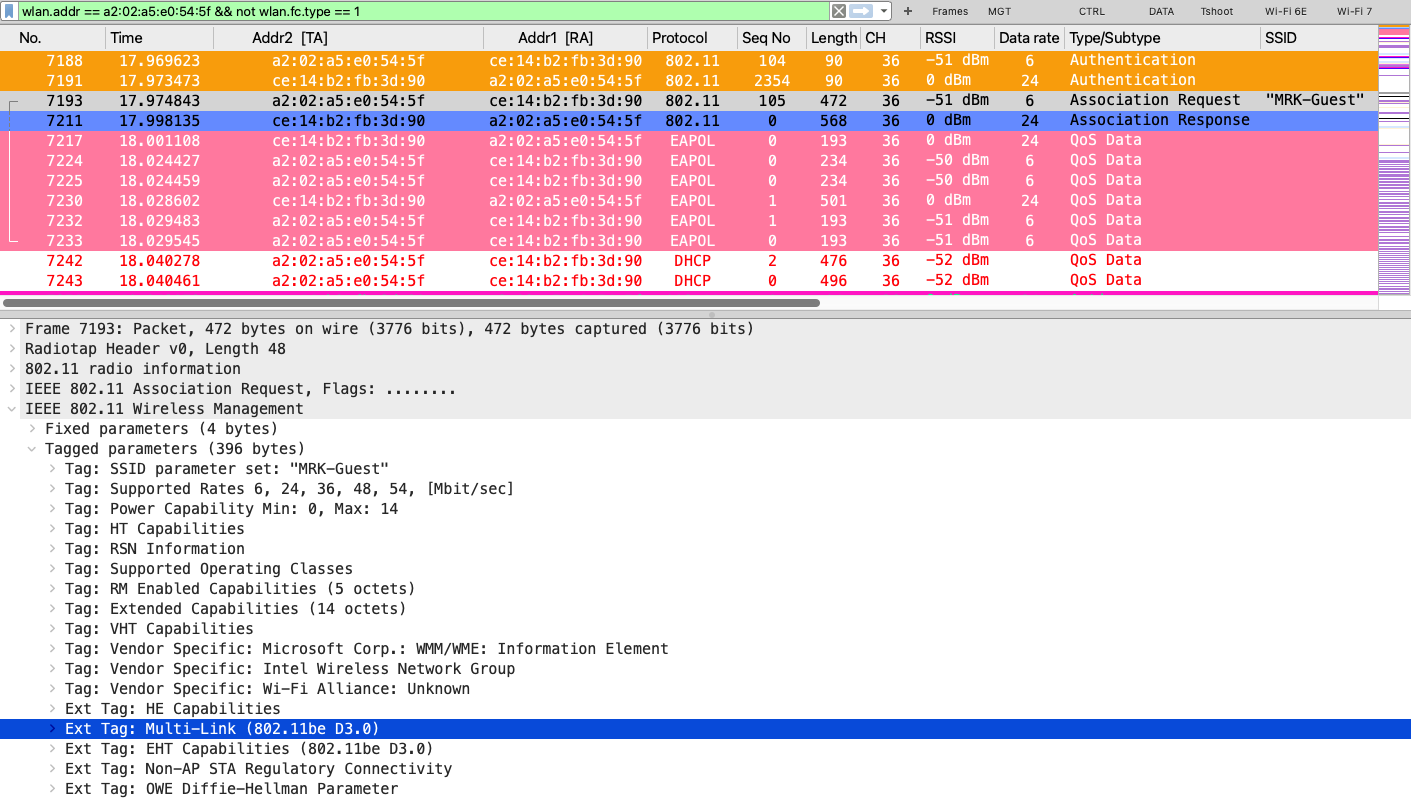
I captured a PCAP on the Meraki access point, and you can clearly see the OWE Parameter element, AKM‑18 in the RSN, and the Multi‑Link Element in the Association Request frame. To filter the BE200 client’s frame exchanges, use the following Wireshark display filter:
wlan.addr == a2:02:a5:e0:54:5f && not wlan.fc.type == 1
When I tested this with my UniFi access point, I noticed there was no option to enable “Enhanced Open” security on an SSID when using an MLO setup. It also appears there’s no clear separation between “Open” and “Enhanced Open” in their SSID security configuration options.
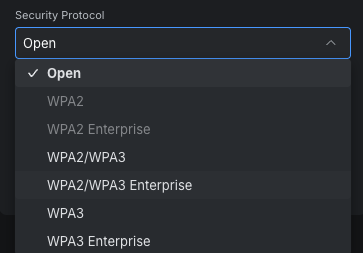
For example if you configure an SSID with multi-band (without MLO) and select ‘Open’ security it configures OWE in 6GHz and no security in 2.4GHz and 5GHz. Without having same OWE security across all links, you cannot establish MLO connection.
C:\Users\mrn>lswifi -inc mrn-ue2026-01-20 08:32:37,134 [INFO] lswifi.app: display filter sensitivity -82; output includes 3 of 61 BSSIDs detected in scan results for a0:02:a5:e0:54:5c.--=+++=~-~~==- -+=+=++-+++--~+=- -~+- -+- -~~+~-- --~~- -- -+=~++=~+=+~- -~+~- -==-~-=~-+~+++- -=-+~~~- -=+-+~=+- SSID BSSID RSSI PHY CHANNEL FREQ. SS AMENDMENTS AUTH ENCRYPTION PMF AP UPTIME[Network Name] [MAC Address] dBm .11 [#@MHz] [GHz] # [802.11] [akm] [unicast/group] [.11w] [approx.]--=+++=~-~~==- -+=+=++-+++--~+=- -~+- -+- -~~+~-- --~~- -- -+=~++=~+=+~- -~+~- -==-~-=~-+~+++- -=-+~~~- -=+-+~=+- mrn-ue ae:05:d6:3f:0f:87 -38 be 132@40+ 5.660 2 d/e/h/k/v NONE NONE Disabled 96d 12:26:40 mrn-ue aa:05:d6:3f:0f:86 -41 be 1@20 2.412 2 d/e/h/k/v NONE NONE Disabled 96d 12:26:39 mrn-ue ae:05:d6:3f:0f:88 -43 be 69@80 6.295 2 d/e/h/i/k/v/w OWE CCMP-128 Required 96d 12:26:42
As we’ve demonstrated, it is technically possible to achieve a Wi-Fi 7 MLO connection with OWE security. However, the roadmap to widespread adoption depends on two factors:
1. AP vendors fully implement the ‘Enhanced Open’ security across all bands.
2. Client devices following suit with stable driver support.
I noticed a few gaps in my lab testing—have you encountered any major vendors that still haven’t fully implemented OWE for Wi-Fi 7? Drop a comment below with your hardware and firmware versions!
 mrn-cciew