
Tags
Continuing our series on evaluating the capabilities of different Wi‑Fi 7 clients, this post takes a closer look at the Samsung Galaxy S24 Ultra. The device is powered by the Qualcomm FastConnect 7800 chipset, which delivers full Wi‑Fi 7 capabilities, including 320 MHz channel support and 4096‑QAM. These capabilities can be verified through Qualcomm’s Device Finder page. This is the first Wi‑Fi 7–enabled smartphone in Samsung’s product lineup, and both the Galaxy S25 Ultra and S26 Ultra continue to use the same chipset. As a result, the overall Wi‑Fi 7 capabilities are not expected to change significantly across these models.
If you’d like to see the full testing and PCAP analysis video, you can watch it here.
When the SSID was configured as tri‑band, I observed that MLO was established across the 2.4 GHz and 6 GHz bands. However, during Speedtest runs, traffic was carried only over the 6 GHz link, with the full 320 MHz channel width in use.
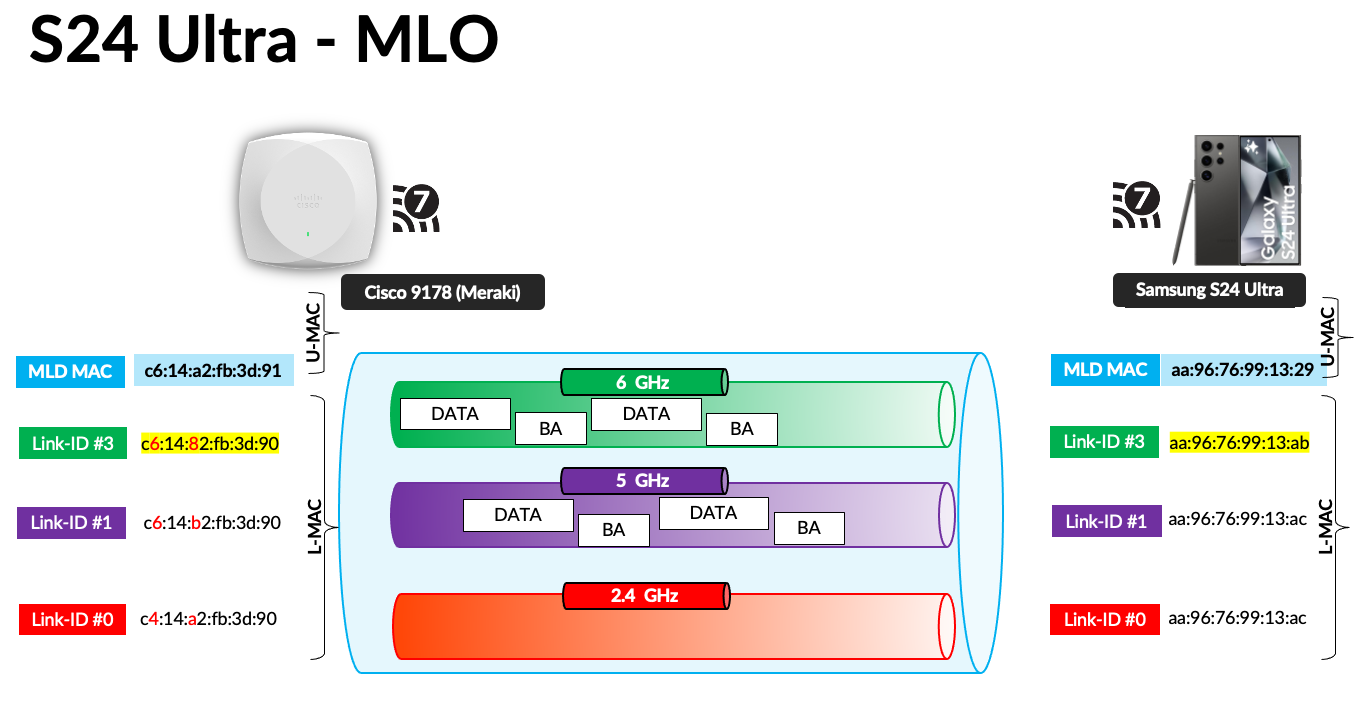
When the SSID was configured for 5 GHz + 6 GHz, the Galaxy S24 Ultra still associated using MLMR‑STR mode. As observed earlier, I did not see traffic being load‑balanced across both links; instead, traffic flowed exclusively over the 6 GHz band, utilizing the full 320 MHz channel width.
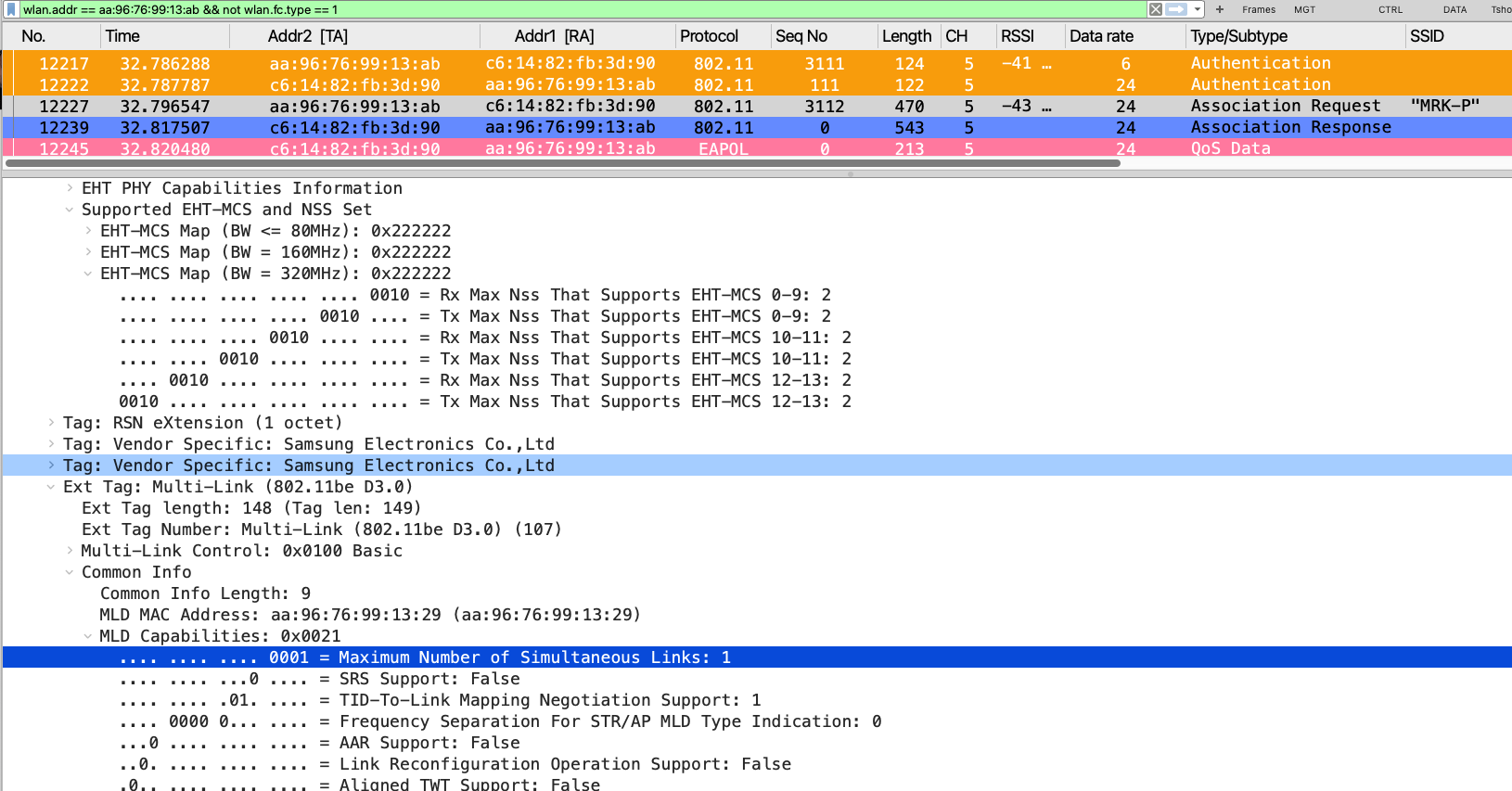
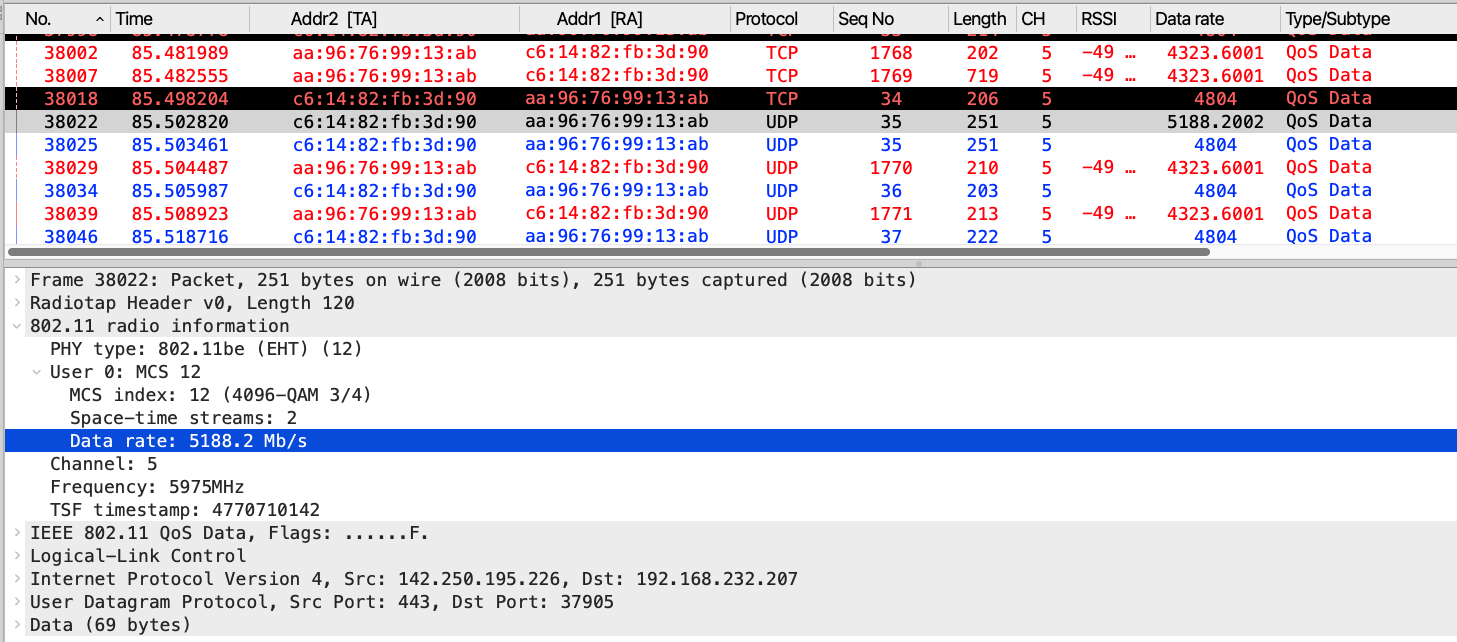
I believe this behavior is due to the availability of 320 MHz bandwidth on 6 GHz. When operating in this mode, the client may not aggregate traffic from additional links as part of MLO. As a result, the maximum PHY rate observed is 5.8 Gbps, which corresponds to MCS 13 (4096‑QAM) with a 320 MHz channel. You can filter S24Ultra traffic using wlan.addr == aa:96:76:99:13:ab && not wlan.fc.type == 1 of those two captures taken during my test.
If you monitor the ‘Data rate’ column, you can find data frames transmitted over 5Gbps in this capture.
We will look at iPhone 16 Wi-Fi 7 capability in next post.
 mrn-cciew